What carnitine does
Carnitine carries long-chain fatty acids into mitochondria to be burned for energy. The liver and kidneys make enough for most people, and meat, fish and dairy add more (ODS).
Two different forms
L-carnitine is the basic form. Acetyl-L-carnitine (ALCAR) carries an extra acetyl group and is the form studied for nerves. The Linus Pauling Institute treats them separately in its research summary (LPI). Nervesignal’s label says “L-carnitine”.
The nerve trials
Two randomised trials pooled 1,257 people with chronic diabetic neuropathy who took acetyl-L-carnitine at 500 or 1,000 mg three times a day (1.5 or 3 g daily) for 52 weeks. Nerve-fibre regeneration and vibration perception improved; pain improved mainly at the higher dose; nerve conduction did not change (Sima et al., 2005).
Nervesignal’s share
Carnitine is fourth in the 575 mg blend, after magnesium glycinate, alpha-lipoic acid and butcher’s broom. Its maximum is a fraction of the blend’s leftover space, a small fraction of the 1,500-3,000 mg acetyl-L-carnitine dose. Details in The 575 mg blend, worked out.
Safety
At around 3 g a day, carnitine can cause nausea, cramps, diarrhoea and a fishy body odour; it may interact with warfarin and thyroid treatment (ODS). At Nervesignal’s amounts, side effects are unlikely.
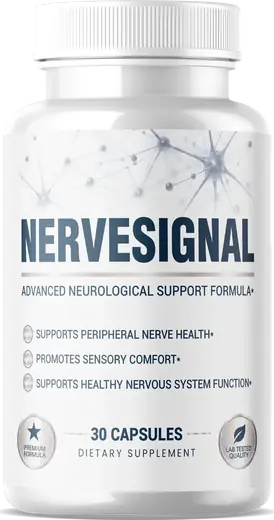
Considering Nervesignal? Two bottles are $158 plus shipping; six are $294 ($49 each) with free US shipping and three bonus guides. Only unopened bottles can be refunded, the seller asks for at least three months of use, and alpha-lipoic acid can lower blood sugar, so read the safety guide first.
Order Nervesignal From $49/BottleQuestions
Is L-carnitine the same as acetyl-L-carnitine?
No. They are related but different compounds; the nerve trials used acetyl-L-carnitine.
Should I take acetyl-L-carnitine instead?
Ask your doctor; the trial doses were 1.5-3 g a day.